


Copy Editing and Proofreading, Who Does What?
- Eliezer J Sherman

- Jan 11, 2021
- 2 min read
Updated: Jun 30, 2021
The most organized (and probably well-funded) newsrooms and content desks understand that it is critical that the copy editor (yes, also spelled copyeditor) and proofreader are two different people. Whether your desk is producing news articles, a press release, scripted video, or marketing collateral, at least two pairs of eyes should be looking at each piece after the writer submits.
It is not that that the copy editor does not care about grammar or typography and the proofreader lacks sensitivity to facts and context (though I have indeed seen examples where this is the case), it is just that when they are in the zone, their talents tend to accomplish different feats. Each one's skill compliments the other.
Read more from Elie Sherman:
Copy editors as creatives versus proofreaders as meticulous
One valuable albeit contrived way to think about it is that the copy editor inhabits a more creative and social space -- connecting with the writer and other editors -- while the proofreader is more technically-inclined and syntactically concerned. The proofreader likely also knows the house style guide front-to-back, while the copy editor is keenly aware of the media strategy.
The nitty-gritty
Most copy is going to pass through at least two copy edits before heading to the proofreader. The managing editor, who has the most authority, will probably read the copy once again before publishing. I am speaking strictly about Internet publishing here because that is where I really have experience. It should not matter too much if everybody physically occupies the same space, or people are working from home.
An easy way to look at it is that the proofreader is a mechanical editor, while the copy editor takes a holistic approach.
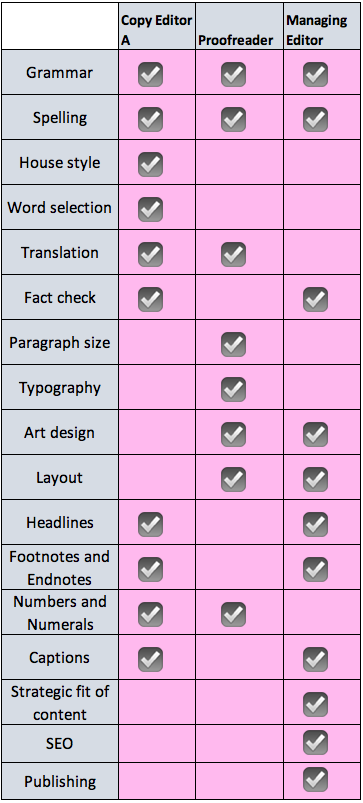
This chart shows what copy editors and proofreaders do
Check out the chart here on the right delineating the basic editing tasks and who is most responsible for each. It is important to note that these rules are not standardized. I made this up. Divvying up tasks allows each editor to focus their attention where it matters, and utilizing the skills they are best at.
And, of course, it helps if the original writer is keeping all these tasks in mind, too! But it need not be his biggest concern. Their job is to write, and their personality should be reflected both in the writing, and throughout the layers of editing, style and grammar permitting.
I have simplified things even further by adding only one copy editor before the proofreader takes over. Happy editing.


Comments